Client and country: L'Oréal, La Roche-Posay; Global
Year: 2024
My role: Partner and Strategy Director, Ogilvy Paris
Context
Skin cancer is the most diagnosed cancer in the world, one of the few still on the rise, and yet the most preventable of all: in most cases, a few simple habits in the sun would be enough to stop it. It is a behaviour problem in its purest form.
The brief
La Roche-Posay, L'Oréal's dermatology brand, runs Save Your Skin: free mole checks for the general public, to catch skin cancers early. It asked us to "level up the game": take the programme's social impact strategy to the next level, and turn it into a model for other L'Oréal brands.
Objective
Levelling up meant three shifts.
Ambition. The brand measured its commitment against skin cancer by what it spent (1% of revenue devoted to cancer). That was an input target. We proposed an outcome target: helping to reverse the curve of skin cancer. This is the difference between CSR, which reports what a company spends, and impact, which commits to what changes in people's lives.
Lever. Reversing the curve means fewer new cases. Screening finds cancers that are already there and does not reduce their number; only prevention can.
Measurement. Counting the habits people adopt, not just the brand's actions.
Our definition of impact: a bold, decisive and legitimate contribution from a brand to a major social issue. For La Roche-Posay, the ambition was therefore to help reverse the curve of skin cancer with an impact that is:
bold, because it takes on a norm as entrenched as the tan;
decisive, because it targets the cancer curve itself;
legitimate, because skin is the brand's expertise.
Problem
Everyone knows they should protect themselves from the sun, and few do. A tan carries social value: it signals beauty, wealth and holidays. And present bias makes us favour the immediate gain over the distant risk: a tan shows the same evening, melanoma years later. Fear-based messages therefore don't change habits.
Audiences
Our research, a literature review and expert interviews, identified three high-risk groups through which to achieve our ambition:
construction workers, among the outdoor workers who account for a third of skin cancer deaths;
European sun-seekers, whom self-care can move where health fails;
children, before the risk builds up over a lifetime: five sunburns before the age of 20 raise the risk of melanoma by 80%.
Strategy
Shift the conversation: from a health message about a distant risk to what already matters in each group's life. Safety at work for builders, self-care for sun-seekers, a protected childhood for parents.
Scenario 1: reducing skin cancer among construction workers

Insight: on a building site, nobody questions the hard hat, because it is the rule and the employer provides it. The sun, on the other hand, is nobody's risk: no rule, no equipment, no recognition.
Recommendation: make sun protection a safety duty, like the hard hat: the responsibility of employers and the law, not just of workers.
Concept: the Skin Union: employers, workers, unions and occupational doctors coming together to make the issue visible and solve it.
Activation:
launch: the brand's screening vans come to building sites;
sustain: the Skin Union takes over all year round;
amplify: get skin cancer recognised as an occupational disease, then reach agriculture.
Success indicators:
protecting themselves every day at work: number of workers wearing sunscreen, a hat, sunglasses and long sleeves, compared between companies with and without vans;
getting screened: number of workers screened regularly;
protecting their teams: number of sites where sun protection is mandatory;
joining the movement: number of Skin Union members.
Scenario 2: changing European sun-seekers' behaviour by reframing sun care as beauty care
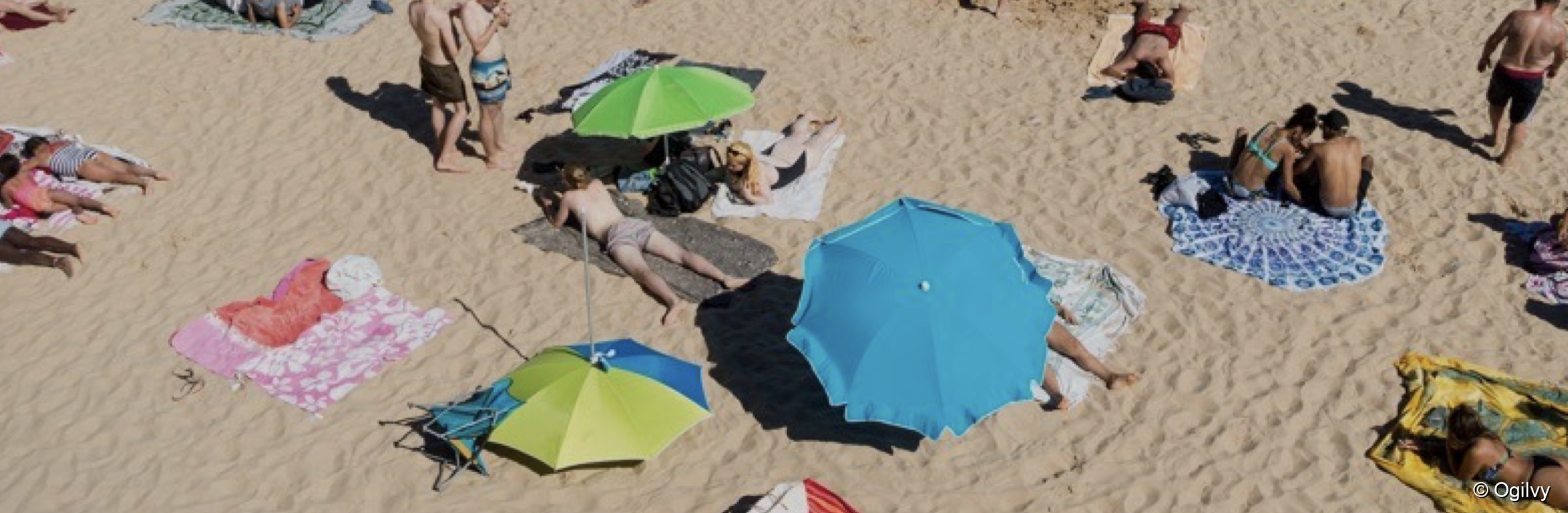
Insight: for sun-seekers, a tan is visible proof of a holiday, and what shows right away wins. But skin ageing shows too, and nobody wants it.
Recommendation: move from fear of cancer to the desire for skin that stays young.
Concept: a cultural programme that sets a new beauty norm: preserving your skin's youth.
Activation:
understand: ethnographic research on sun-seekers and those who influence them;
reframe: content creators, beach activations and tools that show how unprotected skin ages;
set the norm: the beauty industry presents sun protection as everyday skincare.
Success indicators:
protecting themselves on holiday: number of sun-seekers packing and applying protection;
changing the beauty norm: number of influencer and magazine images showing a healthy glow rather than a deep tan;
influencing the sunbed debate: number of European countries debating a ban.
Scenario 3: helping parents entrench sun protection habits in their children before adolescence
Insight: parents think of sunscreen at the beach. In everyday life, at school, in the park or at sport, the sun doesn't register as a danger. Our hypothesis, to be validated by research: even on holiday, they don't protect their children systematically.
Recommendation: make sun protection a reflex, like brushing your teeth, and the new normal for a whole generation.
Concept: a culture change programme that adds a layer of entertainment and mobilisation to the brand's existing initiatives.
Activation:
a published study on the barriers and drivers of children's sun protection, which becomes a brand statement;
an original series, or a character slipped into the shows children already watch (Petit Ours Brun, Choupi);
the Sunproof Generation alliance, from parents to the Ministry of Education;
activations at school, on the beach and at holiday camps;
a range for children, hats and sunglasses included;
advocacy, all the way to sunscreen on the school supplies list.
Why the idea flies: the child's whole community carries the habit, as in Australia, where a child without a hat doesn't go out at break time. And children remind their parents.
Roll-out: three pilot countries with different sun cultures, where skin cancer is rising fastest; extension in year three; all markets by year five.
Success indicators:
protecting their children: number of parents protecting their children every day;
protecting themselves: number of parents protecting themselves;
keeping the habit: number of children keeping it into adolescence;
avoiding sunburn: number of reported sunburns;
remembering the messages: number of children who remember them;
changing the rules: number of measures won through advocacy, from guidelines in schools and holiday camps to sunscreen on the school supplies list.
Why we recommend scenario 3:
Workers: high impact, but far from the brand's customers.
Sun-seekers: already addressed by the sun care range, slow and costly to change.
Children: a whole generation, at the age when habits form, with a direct link to the brand.